


Facing allegations of child pornography is devastating, not only because of the criminal charges themselves but also because of the stigma, fear, and uncertainty that come with them. Many people accused in these cases feel isolated, judged, and overwhelmed as they clash with a system that already seems stacked against them. On top of the threat of prison and a permanent criminal record, individuals may also face civil lawsuits demanding substantial financial damages. This added layer of exposure makes it critical for the accused to have strong legal advocacy protecting their rights and future.
As experienced child pornography criminal defense attorneys, we understand the criminal and civil implications of these charges. We believe you deserve a voice in the courtroom, and that’s our primary job.
In this article, we provide essential guidance for individuals accused of such offenses, outlining the legal framework and potential defenses available to them.
Criminal vs. Civil Restitution: Understanding the Distinction
When someone is convicted of a crime, as part of the sentencing, the court can order them to pay restitution to the complainant. Criminal restitution is typically ordered in conjunction with a period of custody or probation. According to federal sentencing guidelines, criminal restitution is typically limited to quantifiable costs. For example, a defendant can be ordered to pay counseling costs or medical bills. But losses that are difficult to quantify, such as "pain and suffering" or “emotional distress”, often cannot be recovered through criminal restitution.
Key differences between criminal and civil proceedings:
Losses that are difficult to quantify can be recovered through a civil lawsuit. Even a defendant who has fully paid their criminal restitution can face a lawsuit to recover the plaintiff's losses not included in that restitution. The plaintiff cannot recover damages for losses that have already been reimbursed through criminal restitution. Double recovery is not allowed. Payments made in restitution will be credited against any damages the plaintiff obtains in a civil suit.
Types of Civil Damages in Child Pornography Cases
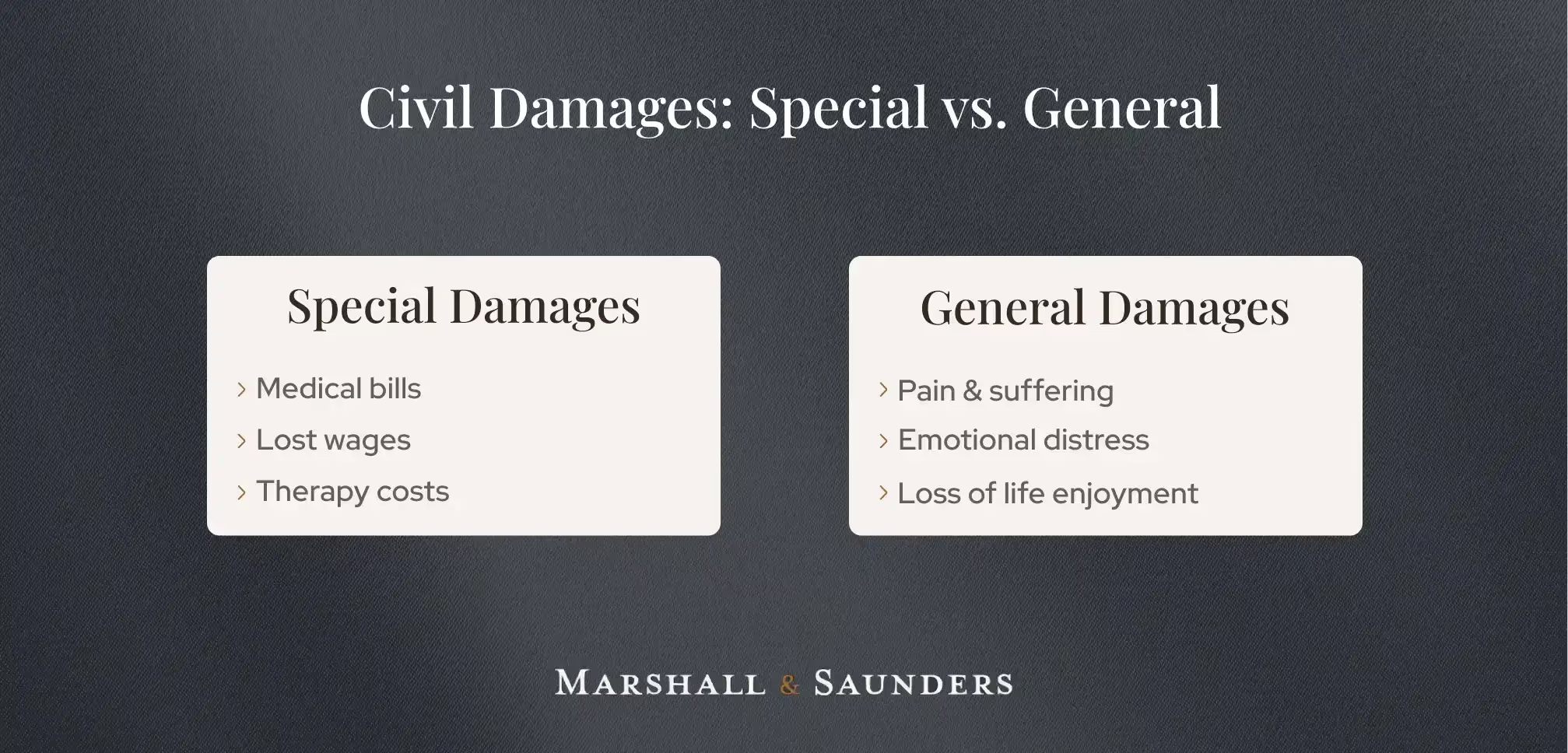
The distinction between losses that can be recovered through criminal restitution and those that cannot roughly parallels the distinction in tort law between special and general damages. Both special damages and general damages may be recovered in a civil suit. Special damages are easily discernible costs, such as medical bills or lost wages.
General damages are less easily discernible. They include categories like “pain and suffering” or “emotional damage,” injuries to which the jury assigns whatever amount it deems fair. Both types of damages must be proven in court by the plaintiff, who is the plaintiff in such a civil suit. The burden of proof in civil proceedings differs significantly from criminal proceedings, requiring only a preponderance of the evidence rather than proof beyond a reasonable doubt.
Generally, a plaintiff who sues the criminal offender in civil court must prove the amount of their damages. This can mean persuading a jury to assign a high value to something like pain and suffering, which people generally do not value in dollars and cents.
Federal Statutory Damages: The $150,000 Presumption
Due to a special federal statute, for individuals who have been photographed, filmed, or video-recorded to create child pornography, any such child (or adult who used to be a child) is presumed to have been damaged in the amount of at least $150,000. This presumption of damages applies to the determination of damages in civil cases, not criminal cases. No proof of the plaintiff's actual damages is required under 18 U.S.C. § 2255. (But the plaintiff is permitted to offer proof that their damages exceed $150,000 and to seek that larger amount.)
Most persons found in possession of child pornography are found in possession of a lot of it. That's because downloading from the internet is quite easy. Law enforcement investigations often reveal that individuals who search for child pornography online may unintentionally download much more than they meant to.
This has consequences for both the length of a criminal sentence and the amount of a civil damages award. The special federal statute allows each individual depicted to be awarded at least $150,000. So if one has possessed images of ten children, for example, one is on the hook for at least $1.5 million.
How Civil Suits Start: The Investigation and Notification Process
The National Center for Missing and Exploited Children has created a repository of child pornography images that are in wide circulation. When child pornography is found on a device and seized from a person during a law enforcement investigation, the following process typically unfolds:
- Images are analyzed using digital evidence forensic tools.
- NCMEC compares the seized images to its repository.
- The Child Exploitation Notification Program notifies identified persons depicted in the images, or guardians or attorneys representing the persons.
- Representatives of those children, or former children who are now adults, learn they have grounds to sue for damages.
- They may then initiate civil proceedings.
There is no requirement that the person who possessed the images be prosecuted criminally; however, most damage suits are filed after a conviction is obtained, as the conviction usually spares the complainant the need to prove that the person possessed their image.
Asset Protection and Legal Defense Strategies
If someone knows they are liable for a civil suit because they possessed child pornography, it is tempting to try to transfer or hide their assets to keep them safe from judgment. This is a grave mistake. Any transfer to protect an asset from a judgment creditor can be declared fraudulent and voided. This remains true even if no suit has been filed at the time of the transfer.
Legal Options for Those Accused
But that doesn't mean there aren't ways to minimize the financial risk. Certain property is exempt from judgment creditors, and there are ways to avoid adding to non-exempt property. When contacted by law enforcement or served with civil papers, the following steps are critical:
- Exercise your Miranda rights — remain silent and request an attorney.
- Contact an experienced defense attorney immediately.
- Do not discuss the case with anyone except your attorney.
- Preserve all relevant documents and communications.
- Make no financial transfers without legal counsel.
Washington State Exempt Property includes:
And, of course, the defendant needs an attorney to explore their potential legal defenses and negotiate potential compromises. Common misconceptions about these cases include believing that:
- Accidental downloading is not a defense
- Deleting files eliminates liability
- Only "real" images count (computer-generated images may also qualify)
- Viewing without saving is not possession (Washington law now covers this)
When Everyone Assumes the Worst, Call Marshall & Saunders. Experienced Defense Attorneys.
At Marshall & Saunders, we have defended numerous individuals against civil damage claims under the special federal statute. We have experience in resolving these complex cases in a manner that benefits our clients.
If you or a loved one is facing any allegations of sexual misconduct, Marshall & Saunders would like to help. We believe that you should not be defined solely by what’s been alleged on a piece of paper. No matter the accusation, we provide a respectful and compassionate defense, telling your story and your history to demonstrate that you are more than what people claim you did. Contact us today for an appointment.


Joshua R. Saunders brings over 15 years of criminal defense experience to the Marshall Defense Firm. His innovative approach, informed by his background in social anthropology and bail reform advocacy, combines legal acumen with a deep commitment to justice and client communication.
Schedule a confidential consultation with our experienced attorneys today.